
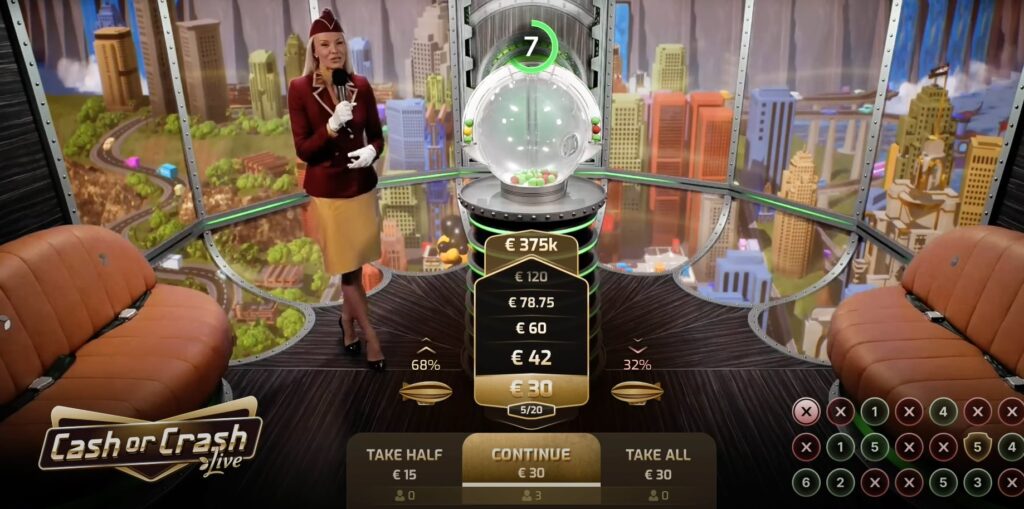
Cash or Crash Live creates its own niche in the world of live game shows. Its appeal resides in a potent mix of studio spectacle and game design that makes each round a personal challenge of nerve. This isn’t just a spin of a roulette wheel. In this experience cash or crash live top bonus, you are in control, making decisions that influence your payout. The concept draws you in with a climbing multiplier, then dares you to grab it before a hidden “crash” resets everything. To maximize your experience, you must ignore the glitz and understand its actual mechanics. Let’s analyze the phases, the presenter’s part, the math behind the risk, and the strategies players can use to manage the excitement.
Methodological Structures and Player Psychology
No strategy can overcome the inherent randomness. But you can employ systematic techniques to manage your money and your emotions. The key trade-off is a trade-off. Do you lock in assured gains, or shoot for massive gains? Players often adopt methods like the “Fixed Cash-Out.” With this approach, you decide ahead of time to withdraw at a certain multiplier, say 2x, in every stage. This seeks consistent, small wins. The opposite is the “Let It Ride” style, where you risk multiple stages for a shot at a huge reward, accepting that crashes will occur. A more strategic tactic is the “Percentage Bankroll” method, where you change your bet size based on your current winnings. The key aspect, though, is in your head. Can you overcome the “greed factor” when the multiplier soars? Can you escape annoyance after an early crash? Your most powerful tool is establishing firm guidelines for yourself before the session even launches.
Typical Mistakes to Evade
Look out for a few typical blunders. The most destructive is “chasing” a failure. This involves recklessly raising your wager after a defeat, which goes against the game’s stage-independent structure. Another misstep is trusting the “hot hand” misconception, believing a streak of large ratios is likely to continue. Permitting the commentator’s talk or the actions of other players divert you from your own pre-set plan is common. Also, don’t misread the sections. The Amber and Red Zones are not tests to conquer. They are alerts that the hazard has increased. Entering any stage without a defined objective transforms the activity from a series of choices into a sheer emotional ride. That journey hardly ever concludes favorably.
Statistical Foundations and Variance
Let’s examine the figures that drive the game. The crash multiplier for each level is based on a set probability distribution. Common, lower multipliers like 1.2x or 1.5x have a high probability of being chosen. Extremely high multipliers are possible, but they are exponentially more improbable. This design keeps the game stable. The common, minor crashes finance the rare, huge potential payouts. The RTP figure is a statistical percentage spanning millions of games. In a single gaming session, the fluctuations are wild. You aren’t betting against the house in a traditional way. You’re acting against a concealed, random value. Remember these points:
- Independent Stages: Every round’s crash point is an independent occurrence. A crash at 1.2x in stage one tells you nothing about stage two.
- No Forecasting Ability: The RNG rules out any predictable sequences. Previous crashes or large wins do not affect future rounds.
- House Edge: The game’s design includes a built-in house edge, as reflected in the publicly stated RTP from the developer.
The purpose of the presenter and RNG
The presenter is more than just talk. They determine the game’s emotional pace. While they cannot influence the result, they masterfully build suspense. They announce the climbing multiplier and provide live updates on what percentage of the crowd is cashing out at each level. That social cue can affect your head. But remember, the host operates independently of the game’s engine: the Random Number Generator (RNG). The crash point for each stage is established by a certified RNG the instant the stage begins. This guarantees fairness and total unpredictability. The host has no clue when the crash will happen. Their job is entertainment. The RNG’s job is certifiable fairness. This combination blends transparent live action with provably random results.
The Primary Purpose and Basic Flow
The aim of Cash or Crash Live is simple on the surface. You have to decide when to withdraw a increasing multiplier before a secret “crash point” concludes the game and claims your winnings for that phase. Each game commences with players putting bets. A rocket then launches its ascent, and a multiplier commences climbing from 1x. The trip has multiple stages. Pre-launch, a hidden crash multiplier is chosen for each stage, secret from all players. As the multiplier climbs, every player decides to hit “Cash Out,” securing that multiplier on their stake, or to remain. If the rocket reaches the secret crash point prior to a player cashes out, they lose their wager for that stage. This cycle of danger and gain occurs over various phases. Players who survive accumulate their profits gradually.
Dissecting the Game Phases
Think of the game as a series of distinct chapters, each a brand new risk. Surviving a crash doesn’t eliminate you. You proceed to the next stage with your collected winnings secure, then start the risk cycle all over again on the following part of the rocket’s flight. This framework is critical. It generates a story, with tension that mounts as you progress. The presenter heightens the tension, announcing how many players are still aboard the rocket as the multiplier reaches impressive levels. Initial phases often see safe plays. Later stages, with their big-winning multipliers, lure you to risk the winnings you’ve already banked. This division is the heart of the game’s appeal. It creates a string of independent, stressful decisions instead of a single one.
From Low to High Risk: The Escalating Risk
Observe the colorful route the rocket travels. It’s a key part of the game’s vocabulary. The opening segment is often a “Green Zone,” a safer phase where a crash is still a possibility. Then, the rocket may reach an “Amber Zone,” a clear indication that danger is rising. The final stretch is the “Red Zone.” Here, multipliers appear their best, but the likelihood of a crash is statistically at its highest. Those hues are not just ornamentation. They provide a visual shorthand for the hazard level at each instant. They turn an theoretical probability seem real. Knowing the game is intentionally informing you about rising volatility is a critical piece of strategic information.
Summary: A Harmony of Fortune and Choice
Cash or Crash Live is a intriguing blend of pure chance and intentional choice. Its workings are built to craft a tale of escalating risk, fueled by a transparent RNG and animated by a charming host. Measuring success as a fun and likely profitable game hinges on various elements. It’s less about predicting the random and more about comprehending how the game is designed. It calls for managing your funds with restraint and managing the mental impulses the game masterfully stimulates. By studying its levels, acknowledging its numeric structure, and adhering to a personal approach, you can transform your perspective. You move from confused uncertainty to informed participation in a remarkably thrilling live game show.